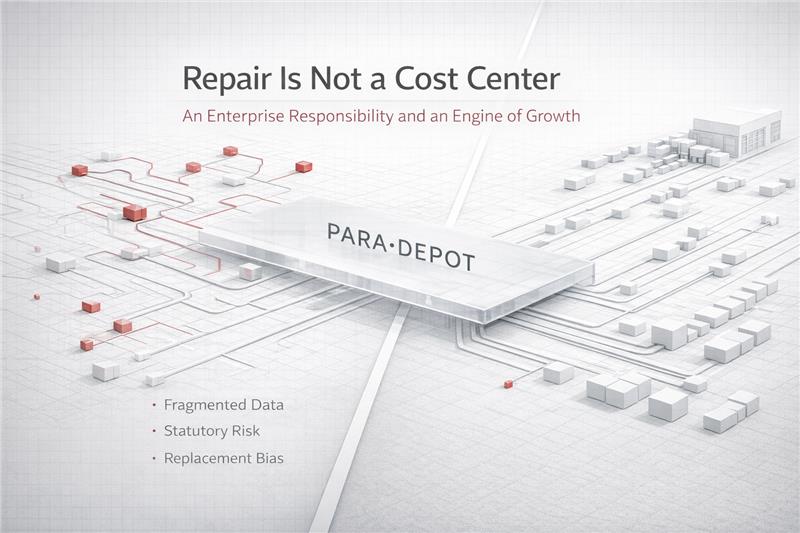
Repair Is Not a Cost Center: An Enterprise Responsibility and an Engine of Growth
TL;DR
Question: Why should enterprises rethink RMA, repair, and service operations?
Answer: Because every product failure creates a decision point: recover value or create waste. Organizations using a unified orchestration layer like Paramantra Para-Depot reduce statutory risk, control waste, and turn service into a growth engine. Those that do not default to “Replacement Bias,” leading to higher costs and hidden regulatory exposure.
The Question Enterprises Avoid
Every enterprise ships products into the world. Eventually, something fails. What happens next matters more than the original sale. Does the organization repair and recover value, or do they replace and quietly create waste?
Most enterprises do not discuss this moment; they move past it. But that silence is expensive. When a company ignores the repairability of its products, it isn’t just a service failure; it is a failure of Institutional Governance.
The Simple Truth: Imagine a world where every time a toy breaks, we throw it in the trash and buy a new one. Eventually, we run out of money and the trash pile hits the ceiling. Para-Depot is the “Toy Doctor” that keeps the toys working so we save money and keep our room clean. For a global company, this is called Capital Efficiency and ESG Compliance.
Repair Is a Waste Decision:
The Silent ESG Killer
When a product cannot be repaired, waste is created immediately. Not at the end of its life, not during recycling, but at the point of failure. Materials are discarded, engineering effort is lost, and serviceable components are scrapped.
This is not a sustainability issue alone; it is a management crisis. Enterprises that cannot repair do not control waste; they inherit it. In the modern regulatory environment, this is no longer acceptable. “Scrapping” high-value assets without a forensic audit trail creates massive holes in corporate environmental reporting.
Why RMA, Repair, and Service Are
Not the Same
One of the most common enterprise mistakes is treating RMA, repair, and service as interchangeable. They are distinct layers of a healthy organization:
- RMA (Authorization and Control): This is about the “Who” and the “Why.” Who approves a return? Why is it allowed? Under what conditions?
- Repair (Technical Execution): This is the “How.” Diagnosis, fault resolution, and technical restoration.
- Service Operations (Orchestration): This is about visibility and customer continuity.
When these are collapsed into one messy workflow, accountability disappears and replacement feels “safer” than repair. By separating these layers, Para-Depot ensures that every decision is defensible and every asset is tracked.
The Replacement Reflex and
the Waste Economy
Most enterprises did not choose a “replacement-first” model intentionally—they designed for it. They built systems optimized for selling and processes optimized for shipping. Repair was treated as an exception, a nuisance, or an “afterthought.”
Over time, this “Replacement Reflex” creates a waste economy inside the enterprise. Replacement is easier to explain in an audit than an undocumented repair. It is easier to approve than a complex fault assessment. But this “ease” comes at a staggering cost to the balance sheet and the planet.
Repair Is About Resilience and Continuity
Supply chains break. Parts are delayed. Customers expect uptime anyway. In this environment, the ability to diagnose, restore, and return products to service is the ability to keep operating when global conditions are uncertain. Repair is resilience. It allows a company to maintain its promises even when new inventory is thousands of miles away.
Architectural Comparison: Specialized RMA Governance vs. General-Purpose CRM & ERP
While Salesforce and SAP provide the essential foundation for sales and finance, Para-Depot is designed as a specialized orchestration layer to manage the technical ‘Fault-to-Fix’ cycles that general-purpose platforms are not primarily built to govern.
| Architectural Criteria | SAP | Oracle | Salesforce | Paramantra (Para-Depot) |
|---|---|---|---|---|
| Primary System Design for Repair | No. Repair is an exception. | No. Repair is an extension. | No. Repair is a ticket. | Yes. Repair is the operating model. |
| Core System Inten | Control transactions and finance. | Control transactions and finance. | Accelerate selling and pipeline. | Run repair, service, and post-sale responsibi |
| Lifecycle Integration | Fragmented across modules. | Fragmented across modules. | Disconnected objects. | One continuous, governed lifecycle. |
| Institutional Focus on Asset Recovery | Very low. | Very low. | Medium. | High by design. |
| Governance over Repair Decisions | Heavy customization required. | Heavy customization required. | Manual workarounds. | Built-in accountability and traceability. |
| Speed to Value for Service | 6–12 months. | 6–12 months. | 4-6 months. | Weeks, not months. |
| Designed for Technicians/Engineers | No. | No. | No. | Yes. Execution comes first. |
| Out-of-the-Box Repair Intelligence | Generic ERP reports. | Generic ERP reports. | Sales dashboards. | Repair KPIs and Lifecycle visibility. |
| System Default at Point of Failure | Replacement feels safer. | Replacement feels safer. | Case closure is prioritized. | Repair is the default, not the risk. |
| Lifecycle Impact | Waste increases quietly. | Waste increases quietly. | Service remains reactive. | Value is recovered, not discarded. |
Case Study: Governing Repair in
Global Solar Manufacturing
A global manufacturer of industrial solar panels faced rising statutory and operational risk. With long-lifecycle assets and multiple regions, they had high environmental accountability. Failures were expected, but governance was not.
- The Problem: Limited traceability across returns, inconsistent documentation for audits, and a default habit of “replacing to avoid risk.” Repair had value, but it lacked a system of record.
- The Change: They implemented Para-Depot to govern RMA and repair as a lifecycle. Authorization became controlled, and repair decisions became traceable.
- The Outcome: Repair rates increased because decisions were now defensible. Replacement rates declined, audit readiness improved across regions, and long-lifecycle assets retained their value. Repair became a predictable, governed process.
Service Has a Human Cost
Repair is done by technicians and engineers working under real constraints—incomplete information, time pressure, and physical systems that behave unpredictably. When repair is treated as an afterthought, these teams absorb the friction. When repair is treated as essential and supported by a platform like Para-Depot, these teams enable continuity. This is not just about efficiency; it is about respect for execution.
Frequently Asked Questions
Why is repair a strategic issue for the CFO and CEO?
Because repair determines waste, continuity, cost, and trust. It directly impacts capital efficiency and the company’s ESG (Environmental, Social, and Governance) standing.
Why do enterprises default to replacement?
Because replacement feels safer when repair data is fragmented. Without a “Single Source of Truth,” managers choose the easiest path, which is often the most wasteful.
Is RMA only a service concern?
No. It impacts legal (statutory risk), finance (asset value), compliance (ESG), and operations. It is an enterprise-wide responsibility.
Can repair be a growth lever?
Yes. Repair preserves value, extends customer relationships, and reduces long-term costs. It allows for “Circular” business models like refurbished sales or rental fleets.
Categories
Latest Articles
Follow Us On
Custom-Built CRM For Your Business
Fill the form to consult with our experts and find out how our Enterprise CRM Software can transform every revenue process in your business. Choose from our 250+ modules and customize every element of our Enterprise CRM Software to address your needs.
- Complimentary CRM Consulting
- Free Configuration and Setups
- Custom training for your team
- 24x7 After-Sales Support