No Invention Arrives Finished: The Automobile as a Case in Engineering Evolution
Every era inherits an unfinished version of a question, and no engineered system escapes this condition. A generation narrows a specific requirement using the tools and materials available at the time, then leaves the remaining variable for a successor once demand shifts and new capability emerges.
This principle governs industrial evolution far beyond any single machine. The automobile offers only one visible record of a pattern operating everywhere else too.
The Automobile as a Brief Record
Nicolas-Joseph Cugnot’s 1769 steam vehicle proved movement without a horse was physically possible. Frequent stops to rebuild steam pressure and no reliable steering kept the design impractical.
More than a century later, in 1885, Karl Benz engineered a vehicle around an internal combustion engine from inception, rather than retrofitting one onto a carriage. Benz filed a patent in January 1886 for what became the first purpose-built automobile.
Neither answer solved production at scale. Henry Ford closed that gap in December 1913, introducing the moving assembly line at Highland Park and cutting assembly time from roughly twelve hours to ninety-three minutes.
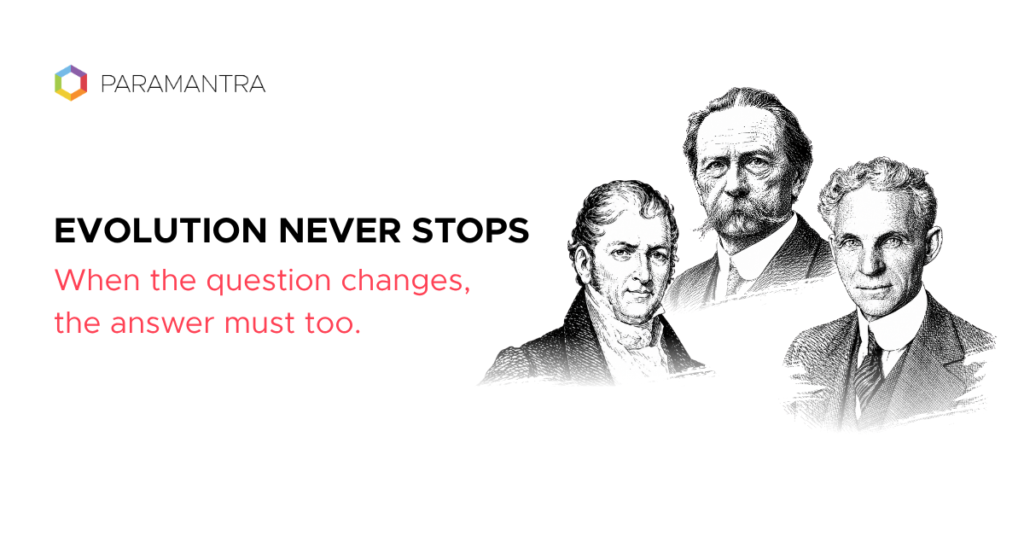
Cugnot, Benz, and Ford never solved the same question. Each closed a narrower one, and each depended on tools, materials, or demand unavailable to the person before him.
Industrial Evolution Runs on Shifting Demand, Not Milestones
A finished invention is a misleading concept, because demand itself never holds still. Manufacturing methods that satisfy one decade’s volume requirements fall short the moment markets expand or buyer expectations rise.
Materials considered advanced in one era become baseline in the next, once new processing techniques make them affordable and widespread. Regulatory environments shift, supply chains stretch across new geographies, and customer expectations move faster than any single design cycle can anticipate.
System upgradation, understood this way, is not a response to failure. It is a structural requirement built into every engineered system from the moment external conditions begin to change around it, which happens continuously rather than occasionally.
A transportation network designed for a smaller population requires different infrastructure once movement patterns shift. A communication system built for one volume of traffic requires different architecture once usage multiplies. A software platform built for one set of operational questions requires different capability once customers, markets, and available technology raise a different set of questions entirely.
Organizations that treat a system as finished tend to discover the gap only once it becomes visible to a customer or a regulator, at which point the cost of closing it has already grown. Organizations that treat evolution as a permanent operating condition, rather than an occasional correction, build the capacity to close a gap while it is still small.
The difference is not a matter of better engineering talent. It is a matter of recognizing that demand keeps moving whether or not a system is designed to follow it.
This is the actual mechanism behind industrial evolution. Advancement rarely arrives as a single decisive leap. Advancement arrives as a continuous sequence of narrower, more specific answers, each one triggered only once a gap between existing capability and current demand becomes wide enough to require closing.
The Same Discipline Shapes Enterprise Platforms
Paramantra has operated inside this exact discipline for more than eighteen years. Current capability did not arrive through a single release, because arrival at a fixed form was never the governing objective.
Every stage of development answered a specific requirement raised by clients across different industries at a particular moment in their operations, rather than a requirement anticipated years in advance.
The client portal, guided by an infinity loop philosophy, addressed a need for continuous visibility into commercial operations, replacing periodic reporting with ongoing insight once static reporting stopped meeting client demand.
Marketing AI Studio and Collection Intelligence emerged once clients needed tools capable of acting on data directly, beyond simple display. Account planning and forecasting capabilities developed as client operating environments grew more complex, requiring structured, repeatable decision support in place of ad hoc analysis.
None of these capabilities originated from a finished platform anticipating future need. Each originated from a defined operational reality, within a particular industry, at a precise point in time, demanding an answer previously unavailable.
Advancement as a Continuous Discipline
The automobile never arrived complete, not in 1769, not in 1886, not in 1913. Each stage closed one specific question and left the following question for a successor to resolve once conditions permitted resolution.
Enterprise platforms answer to the same governing principle. Paramantra’s evolution across eighteen years reflects the exact discipline carrying the automobile from Cugnot’s steam tractor to Ford’s assembly line.
No invention, and no platform, ever reaches a final form. Each one answers the question standing in front of it, and prepares ground for the question arriving next.